

IACUC Review Procedures
The IACUC utilizes various methods for protocol review depending on the type of submission received. The UT Austin IACUC utilizes four methods of review. For more information on each type of procedure, please review IACUC Procedure 4.0, titled “Protocol Review and Notification Procedures” and IACUC Policy 4.4, titled “Veterinary Verification and Consultation and Protocol Changes”.
- Full Committee Review (FCR)
- Designated Member Review (DMR)
- Administrative Review (AR)
- Veterinary Verification and Consultation (VVC)
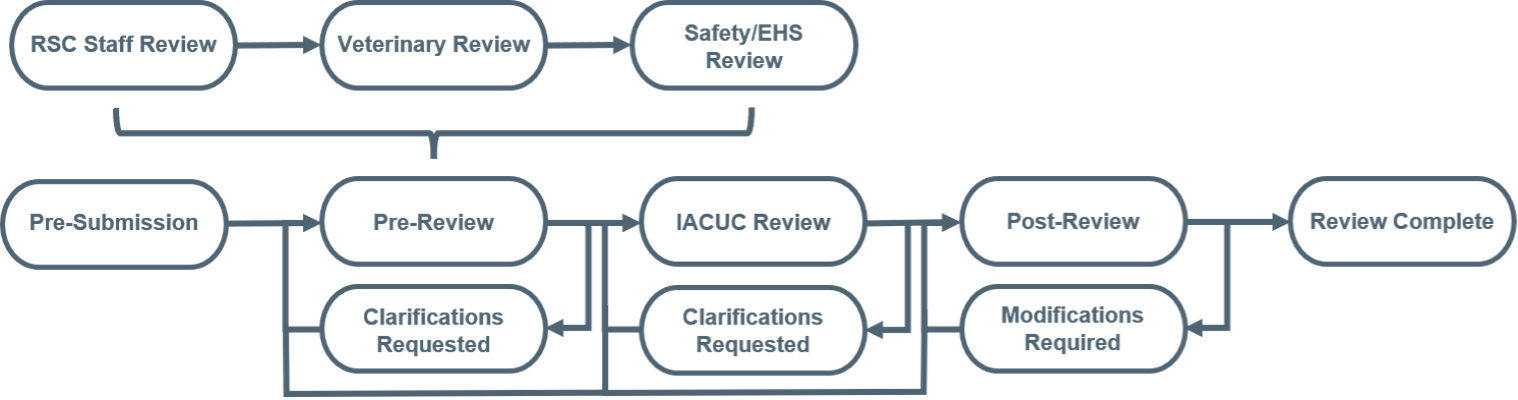
Regardless of the method of review, all submissions will first undergo a pre-review procedure by RSC staff for inaccuracies and confirmation of content prior to being sent to the IACUC. In addition to this office review, protocol submissions in the pre-review phase will also undergo veterinary review, safety review, and possibly an Environmental Health & Safety (EHS) consultation and review if needed. Each of these steps may include multiple rounds clarifications requested before proceeding to the next phase of review. To prevent a delay or lapse in approval, the investigator and IACUC reviewers must actively participate in the review process.
Once pre-review is complete, the protocol will be sent to a 3-day grace period before being assigned to the appropriate review route. Depending on the nature of the protocol, it may or may not require FCR; however, the IACUC has the right to call any submission to FCR if they choose. The protocol is then assigned to an IACUC Member for review. The IACUC Review phase may also include multiple rounds of clarifications requested before approval is granted via Designated Member Review (DMR) and/or Full Committee Review at a convened meeting (see dates below). Regardless of the method of review, final approval of the protocol must be granted before any animal work is permitted to begin. See an overview of the IACUC review phases below.
UTRMS-IACUC Resources
User Resources
UTRMS-IACUC Reference Guide for the Research Community
UTRMS-IACUC Reference Guide for Migrated Records
UTRMS-IACUC Housing & Use Aid
UTRMS-IACUC Animal Justification Aid
UTRMS-IACUC Breeding Information Aid
UTRMS IACUC PI Proxy Guidance
UTRMS-IACUC Procedure Guide
UTRMS-IACUC Protocol Personnel in UTRMS
UTRMS-IACUC Update Animal Use Numbers Aid
UTRMS-IACUC Touring the Dashboard (Video)
UTRMS-IACUC Finding, Copying, Modifying, and Creating Procedures (Video)
UTRMS-IACUC Working with your Migrated Record (Video)
UTRMS-IACUC FAQs (coming soon)
When to Submit
As described above, all protocol submissions must undergo a thorough pre-review to ensure the necessary details are in place prior to being sent to the IACUC for review. Protocol revisions should be submitted at least four weeks before a scheduled meeting to allow sufficient time for pre-review and subsequent reviewer feedback. Furthermore, it is recommended that protocol renewals and complex protocols, such as those with invasive procedures, multiple procedures, and/or novel procedures, be submitted six to eight weeks prior to a scheduled meeting. Protocols submitted outside of this timeframe may not complete the review process in time to be placed on an upcoming meeting agenda.
IACUC Meeting Dates
The IACUC may choose to review any submission at a convened meeting. These submissions are designated as Full Committee Review (FCR). Submissions of increased complexity and concern have a higher likelihood of being designated for FCR. See the IACUC Review Flow Chart for more details.
Scheduled IACUC Meeting Dates
- June 22, 2026
- July 20, 2026
- August 17, 2026
- September 21, 2026
- October 19, 2026
- November 16, 2026
- December 7, 2026
To ask the Committee to discuss a specific item, such as a concern about a specific policy or guideline, please send a request via email to IACUC@austin.utexas.edu. The request must be submitted at least two weeks prior to the meeting date.
The request should contain an itemized list and concise description of any desired agenda item for Committee discussion. The IACUC may require your attendance at the meeting where the discussion item is addressed by the Committee.
IACUC Fees
Fees are assessed in the following situations:
- Animal work conducted at UT under a business services agreement submitted for review by the UT IACUC.
- Animal work conducted in UT facilities on behalf of non-UT institutions when there is no award to UT.
| IACUC Action | Fee |
|---|---|
| Initial Convened IACUC Review | $1,700 |
| Annual Review | $500 |
| Major Modification | $700 |
| Minor Modification | $250 |
| Closure | $100 |
Preparing for Semiannual Inspections
The responsibility of the Institutional Animal Care and Use Committee (IACUC) is to oversee the provisions for the care and well-being of animals used for research, teaching and testing at The University of Texas at Austin. The IACUC is also committed to serving the public by ensuring compliance with all legal and ethical standards regarding the use of animals in research.
One part of that responsibility is to conduct Semiannual Program Reviews and Facility Inspections, as mandated by the Guide, PHS Policy and the Animal Welfare Act. As part of the Program Review, the IACUC will examine the entire animal care and use program, including its own policies and procedures.
The Facility Inspections are conducted to ensure labs are complying with the regulations relating to animal research. The PHS Policy states that the inspection should include all buildings, rooms, areas, enclosures and vehicles (including satellite facilities in which animals are housed for more than 24 hours) that are used for animal confinement, transport, maintenance, breeding or experiments inclusive of surgical manipulation. The purpose of these facility inspections is not to get labs in trouble, but rather to help keep labs in compliance with the regulatory bodies.
What can I do to prepare my laboratory for inspections?
An IACUC staff member will email your lab with the date and time of your inspection and will ask for the contact name and number of a representative from your lab who will meet the committee members. The lab representative should be knowledgeable about the protocol, including familiarity with procedure techniques, drugs or agents used, euthanasia methods, etc.
You can prepare for the inspection by using the “Laboratory Self-Evaluation Checklists” found on the Policies, Guidelines and Forms page.
During the inspection, you can expect the committee will evaluate or review:
- Appropriateness of facilities, personnel and equipment to provide adequate care to animals
- Cleanliness of facilities, lab areas and equipment
- Evaluation of potential hazards and safety considerations for personnel
- Adherence to aseptic techniques
- Animal identification and health records, equipment service records, Standard Operating Procedures (SOPs), controlled substance logs, environmental control, husbandry records, etc.
- Euthanasia practices
- Storage and expiration date of drugs and chemicals used in animals
- Animal husbandry
- Any other considerations listed on the OLAW Inspection Checklists
What can I expect after the inspection of my laboratory?
After the committee has inspected your animal areas, the IACUC will communicate any deficiencies found, along with regulatory background to explain why the correction is needed and in some cases how you can meet the regulatory and institutional requirements moving forward. Your lab is responsible for implementing a plan of correction and you must respond to the IACUC at least 2 weeks following the initial notice. The response should confirm that:
- The item(s) noted have been corrected. Include the date of correction and how they were corrected.
- The item(s) noted will be corrected. Include the anticipated date of correction and a written plan for how they will be corrected.
The IACUC staff will follow up with your lab until all deficiencies have been addressed and finalized. Some areas may be revisited to confirm the deficiencies have been corrected. If you have any questions or concerns or if you would like additional information on how to prepare your lab for inspections, please email the IACUC at iacuc@austin.utexas.edu.