

Translating Research Insights into Progress and Hope for Inflammatory Breast Cancer
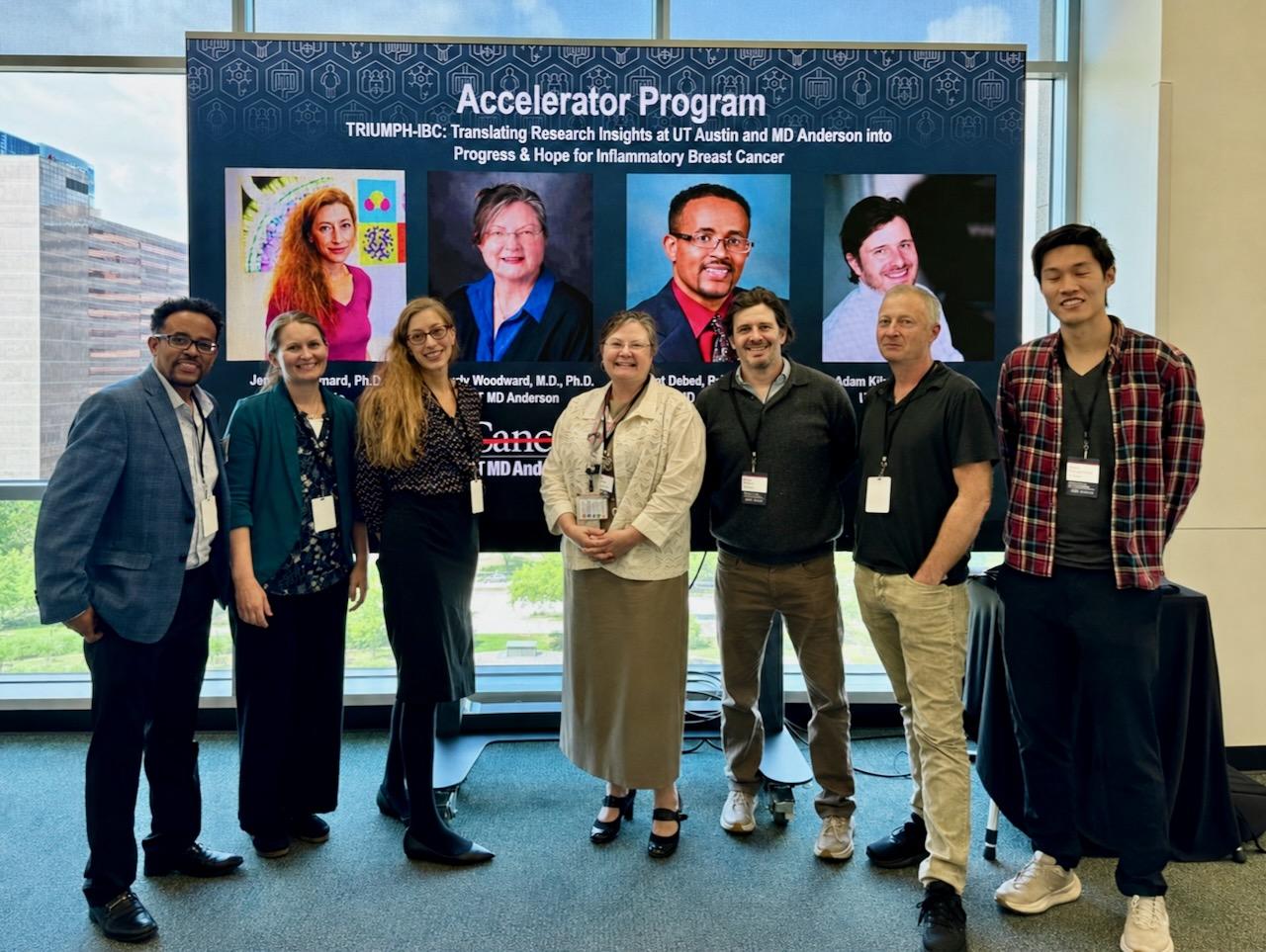
Inflammatory breast cancer spreads quickly, often goes undetected by standard screening and has no treatments designed specifically to fight this deadly disease. Researchers at The University of Texas at Austin and The University of Texas MD Anderson Cancer Center are joining forces to change that.
TRIUMPH-IBC — Translating Research Insights at UT Austin and UT MD Anderson into Progress and Hope for Inflammatory Breast Cancer — is an interdisciplinary and multi-institutional research project supported by the Collaborative Accelerator for Transformative Research Endeavors (Accelerator), which funds ambitious, five-year research with the potential to transform cancer care, diagnosis, and prevention by addressing unmet needs in oncology.
The TRIUMPH-IBC research team is driven by the question, "How can we improve outcomes for patients with hard-to-treat breast cancer?"
By combining the biochemistry and machine learning expertise at UT Austin with the unmatched clinical research and cancer care expertise at UT MD Anderson, the team aims to develop novel therapeutics that more effectively treat and eradicate inflammatory breast cancer (IBC) and triple negative breast cancer. These two types of breast cancer together account for over a third of all breast cancer deaths because they are highly aggressive, don't respond well to standard treatments, such as chemotherapy, and often develop resistance to treatment.
"IBC is a terrible breast cancer — you often can’t find it on a mammogram," said Wendy A. Woodward, executive director of the Morgan Welch IBC Clinic and Research Program at UT MD Anderson and a lead researcher on the TRIUMPH-IBC project.
Woodward explained that IBC patients are often misdiagnosed with mastitis when they first show symptoms, because symptoms are not typical of cancers. "Patients are delayed to diagnosis and are usually diagnosed with at least stage three. 30 percent of patients will present with stage four because it just took too long to get diagnosed with a fast-moving disease," explained Woodward, who also serves as a professor of cancer research and Department Chair ad interim for Breast Radiation Oncology.
Woodward emphasizes that this research will address a critical gap, "We still don’t have any IBC-specific therapies, so we’re working to try to understand what’s different, what drives the disease, and how we can really make a difference."
Woodward is a breast radiation oncologist who is also trained as a molecular biologist and has long been passionate about addressing unmet needs for inflammatory breast cancer patients. The Morgan Welch IBC clinic that she leads was the first dedicated IBC clinic in the world and will be celebrating its 20th anniversary this fall.
Woodward's team has laid the groundwork to understand how IBC presents in patients and identify the biggest needs and most promising new treatment targets. UT Austin researchers will use their expertise in biochemistry and molecular biology to develop antibodies and other proteins that recognize unique targets on IBC cells as potential new therapeutics to treat IBC. Then, experts at UT Austin's Institute for the Foundations of Machine Learning (IFML) will use machine learning tools to help engineer those targeted therapies and prioritize the ones that show the most promise for patients for pre-clinical testing and, eventually, clinical trials.
Research Associate Professor Everett Stone, who engineers enzymes to treat cancer, contributes additional protein-based strategies for development into next-generation IBC therapies. At MD Anderson, Woodward collaborates with Associate Professor Bisrat Debeb, a Co-PI and expert in IBC metastasis and treatment resistance, whose group is evaluating potential therapies in models of the disease.
"The goal is to evaluate multiple different potential tumor targets, identify the best, and ideally develop some therapeutics that can help people," said Jennifer Maynard, professor and department chair of Chemical Engineering at UT Austin, who is also a research leader on the TRIUMPH-IBC project. "While doing this, we also aim to set up a collaborative pipeline where UT and MD Anderson are working toward our shared goal of making therapeutics to help cancer patients."
Maynard has researched antibodies for most of her career and began thinking about the applications for cancer treatment when she started working with Research Assistant Professor Annalee Nguyen in the McKetta Department of Chemical Engineering over a decade ago. Nguyen was deeply motivated to use her expertise in antibodies to develop better treatments. Maynard’s and Nguyen’s collaborative leadership in this area makes UT Austin well-positioned to start developing new antibodies and protein-based therapies that target IBC as they work closely with Woodward’s team at UT MD Anderson.
“The TRIUMPH-IBC collaboration allows us to take that history and knowledge and basic science about what’s driving the aggressiveness of IBC, utilize some of these really amazing patient resources that we have to do transcriptomic analysis and prioritize targets and then partner with the teams at UT Austin who know how to turn that into therapies,” Woodward said.
Overcoming Challenges Presented by Difficult, Aggressive Breast Cancers
Maynard and Woodward see two primary, intertwined challenges when it comes to IBC. One challenge is that it is often misdiagnosed because it doesn't show up like other cancers. "It's a very different cancer — it grows differently," Maynard said. "It doesn’t grow in one solid mass. It invades your lymphatic tissues and blocks fluid drainage." The other challenge is that there are not any good treatments for IBC. "It does tend to have a very high fatality rate because it is diagnosed so late, so that’s why we thought it was the right opportunity to make some of these new antibody-based, or protein-based, therapeutics," Maynard said.
This year, the research team developed methods to fine-tune candidate drugs, using approaches informed by deep learning and machine learning.
Using AI and Machine Learning to Identify the Most Promising Therapies to Test
A deep understanding of antibodies is crucial to creating drugs that will effectively treat IBC while preserving healthy cells and tissues to promote the best possible results for patients.
"Antibodies have dramatically changed the ways cancers are treated and the outcomes for a lot of different patients," Maynard said. "Antibodies are special because they are these Y-shaped proteins. The ends of each arm grab on to another molecule — it’s almost like puzzle pieces — and they can attach to a molecule that is abundant on tumor cells but not present on healthy cells. Depending on the design, antibody binding can cause the tumor cells to self-destruct or they can be used to bring chemotherapy specifically to the diseased cells to selectively eliminate the cancer cells while sparing healthy tissues."
Maynard is interested in learning from UT MD Anderson’s understanding of IBC to identify vulnerabilities in the disease that can be targeted with protein-based therapeutics to fight the cancer.
UT MD Anderson provides the world’s foremost care to IBC patients and has a wealth of knowledge when it comes to how the cancer progresses, how current treatments affect patients and the gene expression patterns that drive biological processes in IBC. Some of this is what is called transcriptomic data — a comprehensive catalog and quantitative measurement of all RNA molecules in a cell, tissue or organism at any given time. Experts at UT MD Anderson are using deep learning tools to analyze their vast amount of IBC-specific transcriptomic data and identify biomarkers of the cancer, which are targets for antibodies.
"The goal is to set up a ranked list of really robust, well-vetted targets and work together to test antibodies and protein-based therapies that are directed at these targets and try to figure out what’s the most likely home run to advance into the clinical setting," Woodward said.
While the UT MD Anderson team uses deep learning to take some of the "guess work" out of identifying targets for new therapies, computer science professor Adam Klivans and the team at the University’s IFML are helping to speed up the testing process for new drugs. They are using cutting-edge machine learning techniques to help better engineer the new therapeutics and to identify the most promising ones to advance into pre-clinical and clinical trials.
"Adam Klivan’s team at UT is using AI to determine, out of all of the different ways we could make this antibody, what’s the most fruitful way we could do it?" Woodward explains.
The Ultimate Goal: Therapeutics That Provide a Cure
The TRIUMPH-IBC team is motivated to conduct research that is quickly integrated into practice across the health care ecosystem to help IBC patients.
"Some treatments that are considered successes may only extend someone’s life by three months," Maynard said. "That’s helpful, but that’s not a whole win. The ideal outcome is to find new therapeutics that can provide a cure."
She emphasizes the difficult path to achieving the goal but is eager to help provide better solutions. "The vision that I have is developing a novel therapy like Keytruda, which is an antibody that revolutionized cancer care. If we can find something else that is like Keytruda that can work, that would be the dream. That may be a 20-year outcome, but that’s the ultimate outcome."
Woodward shares more about what she hopes the team will accomplish during the course of the project: "My ideal situation is that we would have at least three targeted antibodies that we have generated that we would be able to walk through the steps pre-clinically and show that they’re really treating animals."
After preclinical trials, the next steps she envisions include licensing, manufacturing and a full clinical trial. "That is another thing that’s really great about the collaboration between UT MD Anderson and UT Austin — there are a lot of capabilities to figure that piece out and not just make an antibody but get it into the clinic," Woodward said.
Building a Long-term Collaboration with Transformative Impact
Over the next five years, the team has a strategic plan to achieve these life-changing and practice-changing goals. But they’re also looking beyond the scope of their project, committed to long-term collaboration that could transform the field of cancer research with benefits for people battling all types of cancer.
"We are working to build a connection between UT Austin and UT MD Anderson where we can work together not just on this one cancer but on many cancers to create therapeutics," Maynard said.
Woodward shares the sentiment. "Together we can go beyond suggesting solutions and actually make solutions." As TRIUMPH-IBC researchers look forward, they hope the collaboration they build will serve as a robust foundation for a joint “center of excellence” that continues this research across disciplines and institutions.
"A lot of this type of research occurs in companies, so it’s actually quite unusual for a university environment to make molecules and try to evaluate them and push them forward as therapeutics," Maynard said. "This is an opportunity for Texas to create a new model for making drugs, and, through public-private partnerships, have them be affordable as well as effective."
Read more about TRIUMPH-IBC and the project team on the Texas Research website, learn more about their recent work in Neuro-Oncology, and follow along on LinkedIn for updates.