

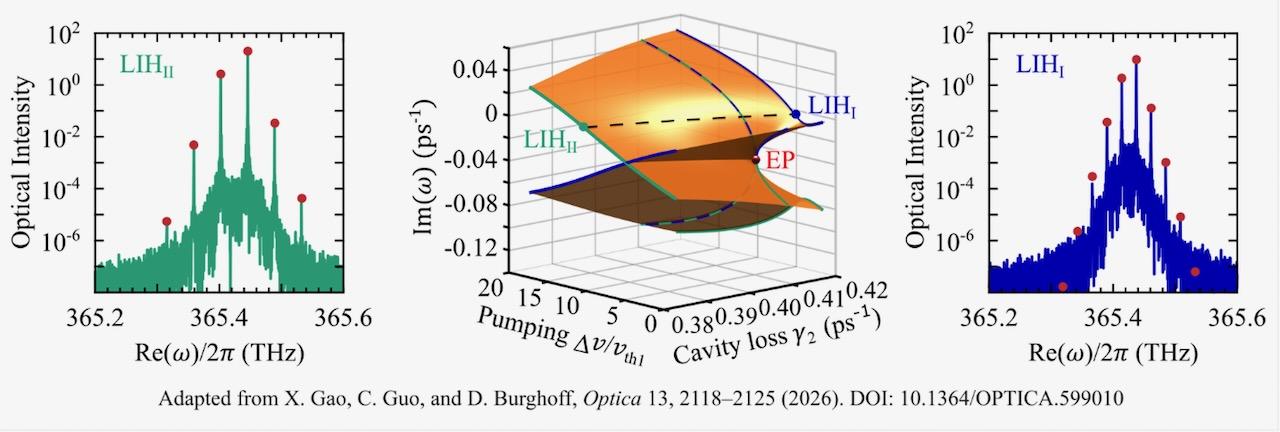
David Burghoff’s group, in collaboration with Assistant Professor Cheng Guo, has identified a mechanism that allows lasers operating near exceptional points to switch between single-mode emission and frequency combs with different repetition rates.
Xingwei Gao, Cheng Guo, and David Burghoff report the findings in "Mode switching through exceptional points induced by lasing–inversion coupling," published in Optica.
In a laser system, the dynamical interaction between population inversion and the optical field can create a non-Hermitian degeneracy known as an exceptional point (EP). The resulting spectral structure enables switching between distinct frequency-comb states with different line spacings. Although noise can be strongly amplified near EPs, this comb-switching mechanism remains robust because it is governed by the global topology of the Riemann sheets around the EP, rather than by the singular sensitivity associated with the divergent Petermann factor.
The results provide a route toward controlling laser output through pumping and cavity loss. This mechanism could support reconfigurable photonic systems for adaptive optical communications and dual-comb spectroscopy.
This work was funded by DARPA, AFOSR MURI, NSF, and the Moore Foundation.